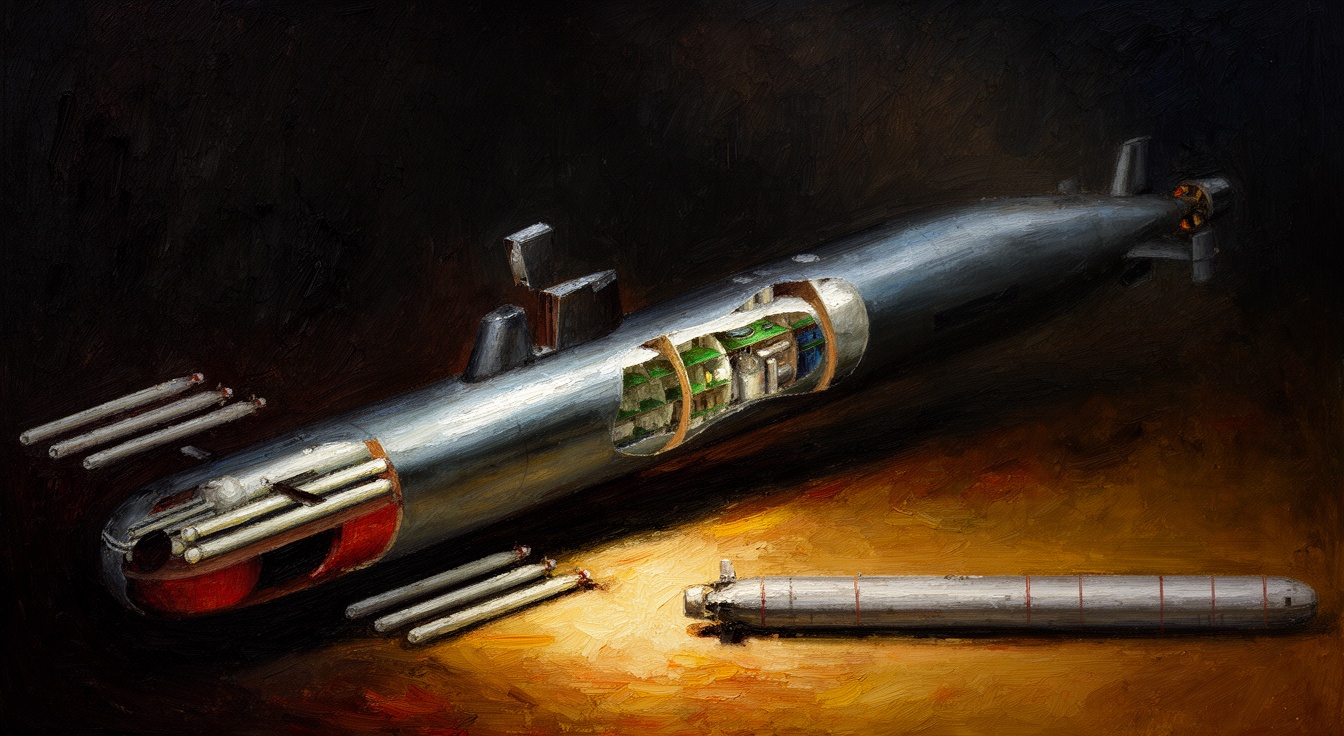
Russia Advances Super-Weapon Submarine Khabarovsk Development
Russia is enhancing the capabilities of its Khabarovsk submarine, integral to its 'invincible' weapon program. This includes the Poseidon intercontinental torpedo, which poses a strategic threat to naval forces.
New developments regarding Russia’s Khabarovsk submarine reveal a significant focus on enhancing its capabilities. This class of submarine, which integrates advanced technologies, is a key component of Russia’s super-weapon initiative first unveiled by President Vladimir Putin in March 2018, characterized as 'invincible' and designed to evade interception.
The Khabarovsk is particularly notable for its deployment of the Poseidon system, a gigantic nuclear-powered, nuclear-armed intercontinental torpedo. Described as a revolutionary weapon, the Poseidon is functionally a drone but operates similarly to a massive torpedo, capable of delivering nuclear payloads to targets at extreme distances. Its design and potential for stealth pose a considerable threat to existing naval defense systems.
Strategically, the advancements in Khabarovsk's capabilities signify Russia's continued commitment to modernizing its military fleet and maintaining a competitive edge over NATO and other military powers. The emphasis on submarine warfare, coupled with the development of such advanced weaponry, heightens tensions in global naval theaters.
Operationally, the Poseidon is intended to circumvent conventional defenses through its unique operational profile and capabilities. This weapon can travel at high speeds and operate underwater for prolonged durations, rendering it challenging to detect and intercept. The integration of these technologies into the Khabarovsk enhances Russia’s strategic deterrence posture.
Consequently, the continued development of the Khabarovsk submarine and its associated systems may lead to an escalation of naval armaments race, impacting the balance of power in international waters. Analysts predict that this could provoke countermeasures from adversaries, further intensifying maritime tensions and fostering an environment of competition among global naval powers.