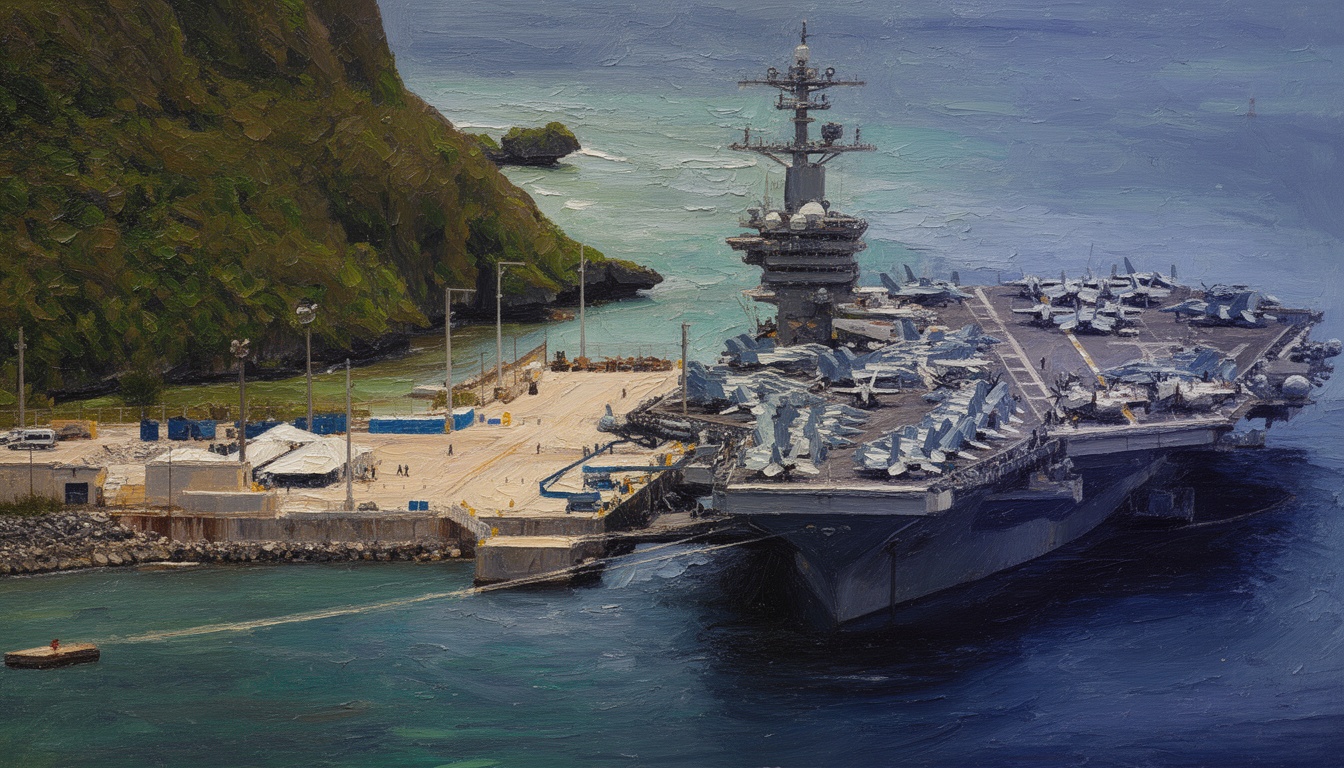
PLA Scientists Propose Plan to Destroy US Carrier Groups from 3,000km
Chinese defense scientists have developed a strategy to target US naval capabilities from significant distances. This approach addresses the challenge of US carrier groups relocating beyond conventional missile range.
Chinese military scientists have proposed a new military strategy intended to neutralize United States aircraft carrier groups from distances as far as 3,000 kilometers. This development comes as the US retracts its naval assets to areas like Guam, well beyond the operational range of many conventional missiles. The strategic shift is seen as a tactical retreat, yet it presents a complex challenge for the Chinese People's Liberation Army (PLA).
In modern naval warfare, the retreat of US carrier groups to offshore locations signifies a significant operational alteration. The dispersion of these assets complicates the targeting strategies of potential adversaries. As these carrier strike groups regroup at bases such as Guam, the focus of military technologies becomes critical in countering their capabilities. Hence, the problem facing these Chinese defense scientists hinges on finding effective systems to counter distant naval assets.
The plan unveiled by the Chinese scientists includes innovative technologies that could enable standoff capabilities against hardened naval positions. Details regarding the specific weapon systems employed, such as long-range hypersonic missiles or advanced cyber warfare tactics, remain classified. However, the very fact that the PLA is actively developing means to extend their strike range represents a profound shift that could alter the balance of maritime power in the Asia-Pacific region.
Operationally, if the proposed technologies are successfully implemented, these capabilities could allow the Chinese military to project power into areas previously dominated by US naval forces. The implications of this are far-reaching, affecting naval strategy and defense policy not only in the Asia-Pacific but potentially globally. Military experts will closely monitor these developments as the PLA continues to evolve its strategy in response to shifting US naval deployments.
In conclusion, the initiative by Chinese scientists reflects a significant advancement in military strategy, poised to challenge the operational dominance of US carrier groups. Should these capabilities materialize, they could redefine engagement rules in the maritime domain, reinforcing China's position in regional and international security discussions.