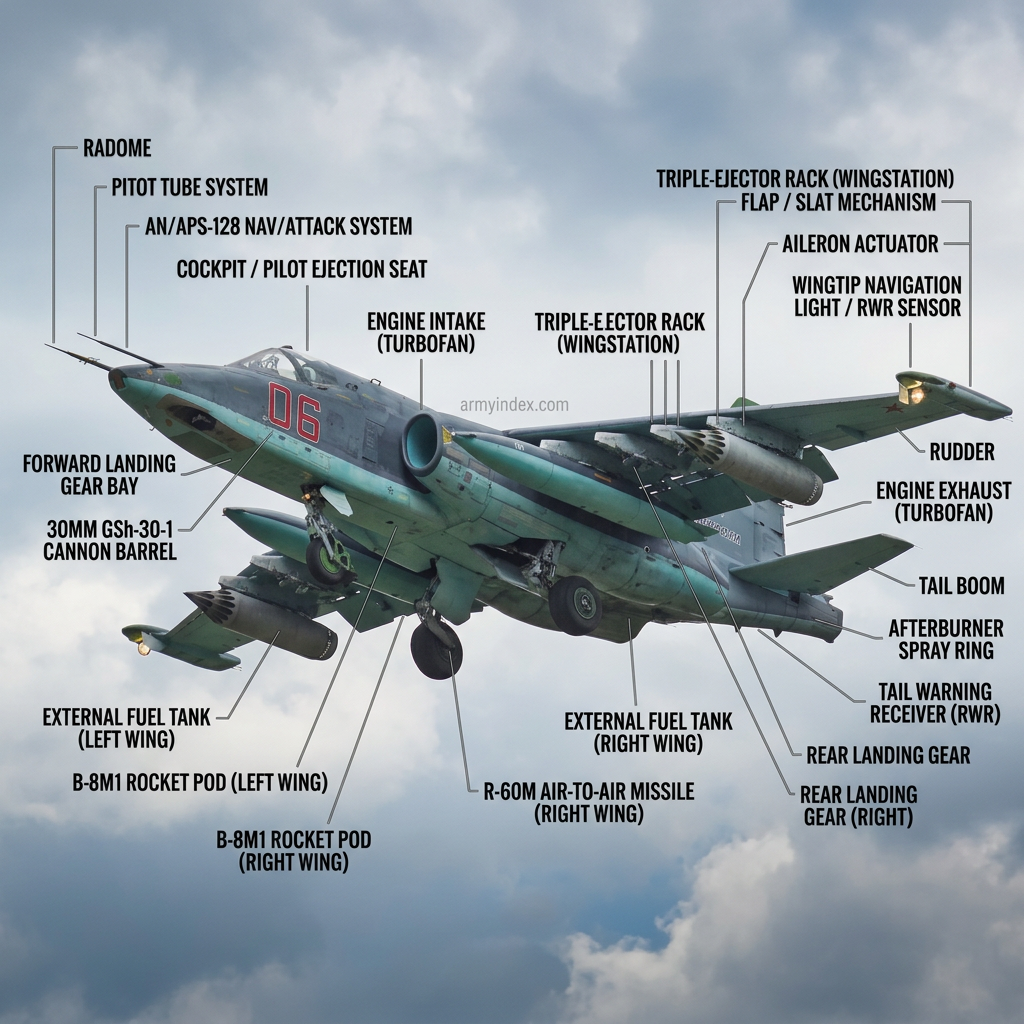
Su-25 Frogfoot
Type: Close Air Support Aircraft
Domain: air
Country of Origin: Russia
Manufacturer: Sukhoi
First Deployed: 2002
Overview
The Sukhoi Su-25 Frogfoot is a Soviet/Russian single-seat subsonic close air support aircraft first flown in 1975. Its titanium armored cockpit provides protection against ground fire, and ten hardpoints carry up to 4,340 kg of ordnance including unguided bombs, rockets, air-to-surface missiles, and a 30mm GSh-30-2 twin-barrel cannon. Widely exported throughout the former Soviet sphere and Africa. Combat-proven in Afghanistan, Chechnya, Georgia (2008), Ukraine (2014-present), Syria, Iraq (against ISIS 2014), and numerous African conflicts.
Technical Specifications
| crew | 1 |
|---|---|
| length | 15.53 m |
| engines | 2x Soyuz R-95Sh / R-195 turbojet |
| armament | 1x 30mm GSh-30-2 cannon; 10 hardpoints for rockets, bombs, missiles (S-5, S-8, S-24 rockets, R-60 AAM) |
| wingspan | 14.36 m |
| max_speed | 975 km/h |
| combat_radius | 375 km |
| service_ceiling | 7,000 m |
| max_takeoff_weight | 17,600 kg |
Operators
- Angola
- Armenia
- Azerbaijan
- Belarus
- Bulgaria
- Burkina Faso
- Central African Republic
- Chad
- Congo-Brazzaville
- Czech Republic
- DRC
- Eritrea
- Ethiopia
- Georgia
- Iraq
- Ivory Coast
- Kazakhstan
- Kyrgyzstan
- Macedonia
- Mali
- Namibia
- North Korea
- Peru
- Russia
- Slovakia
- Sudan
- Tajikistan
- Turkmenistan
- Ukraine
- Uzbekistan
Related air Weapon Systems
- JF-17 Thunder - Multirole Fighter (Pakistan)
- CH-7 - Surveillance UAV (China)
- Skydagger RTF 7" - FPV Drone (Türkiye)
- EDGE Reach-S MALE UCAV - Combat UAV (UCAV) (UAE)
- F-15IDN - Multirole Fighter (United States)
- F-7BGI - Air Superiority Fighter (China)
- AS332 Super Puma - Attack Helicopter (France)
- Toufan / Saba / Shahed-285 Helicopter Family - Attack Helicopter (Iran)
- Guizhou FTC-2000G - Close Air Support Aircraft (China)
- SOM - Air-Launched Cruise Missile (Türkiye)